Catch vulnerabilities before they ship
AuditDude scans every push with Claude, flags what's exploitable, and throws away the rest. Your code never trains anyone's model.
How it works
Three steps. The first scan is free.
No credit card, no agent to install, no YAML. Read-only access you can revoke anytime.
Sign up free
Log in with GitHub. Read-only access, no credit card, nothing runs in your infrastructure.
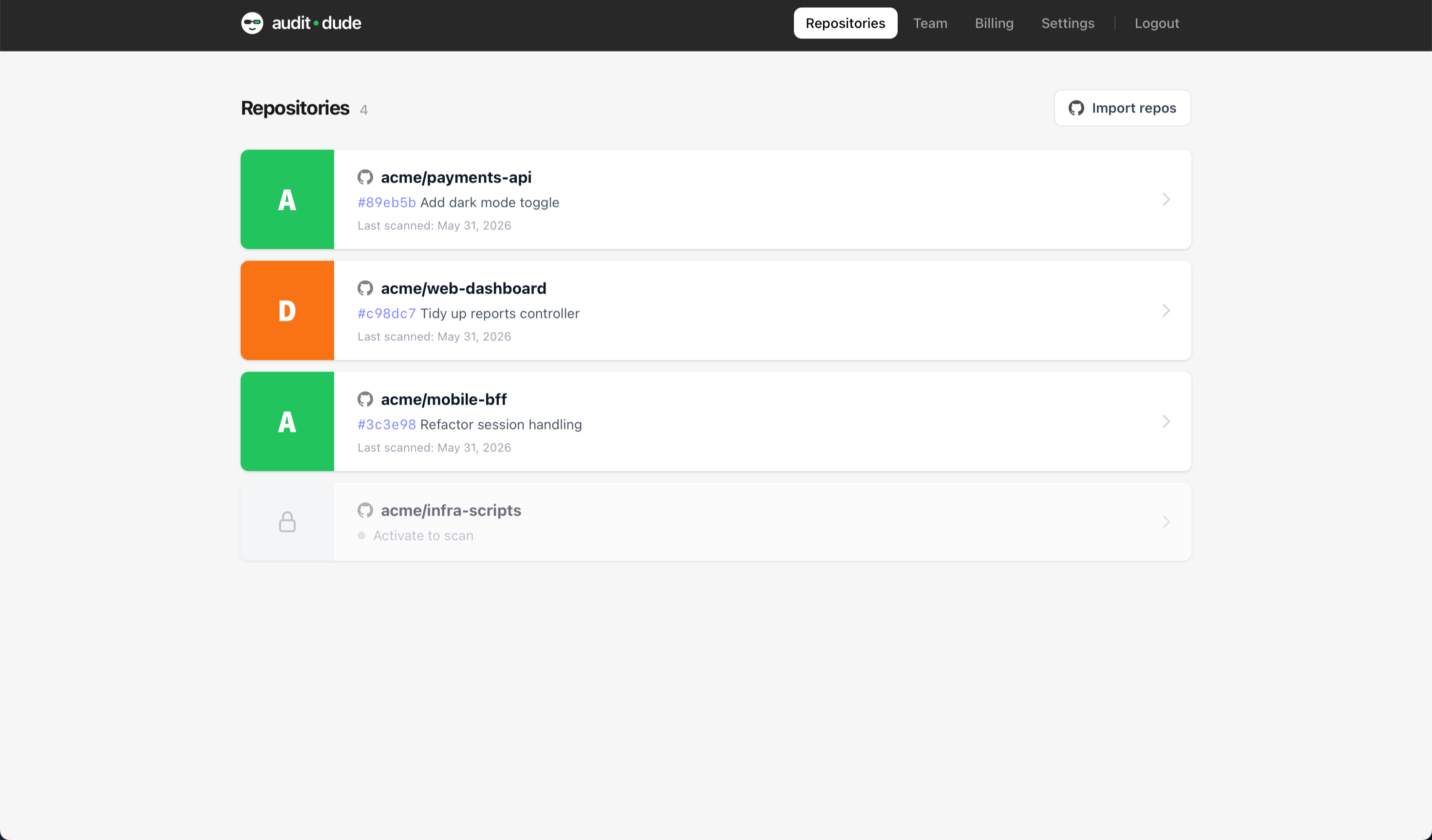
Pick your repos
Choose what to protect. AuditDude scans the whole repo on connect, then watches every push.
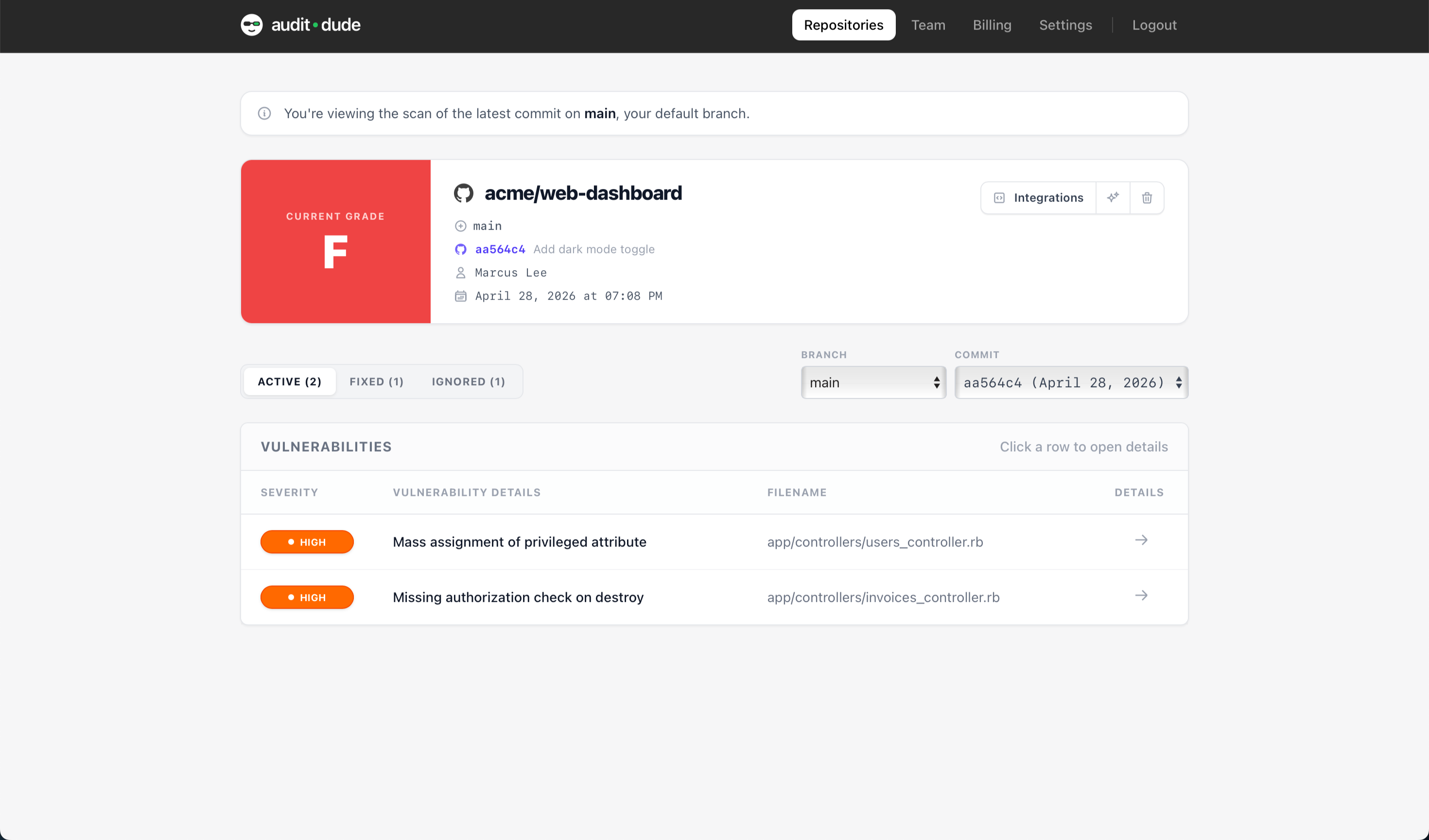
Read findings in minutes
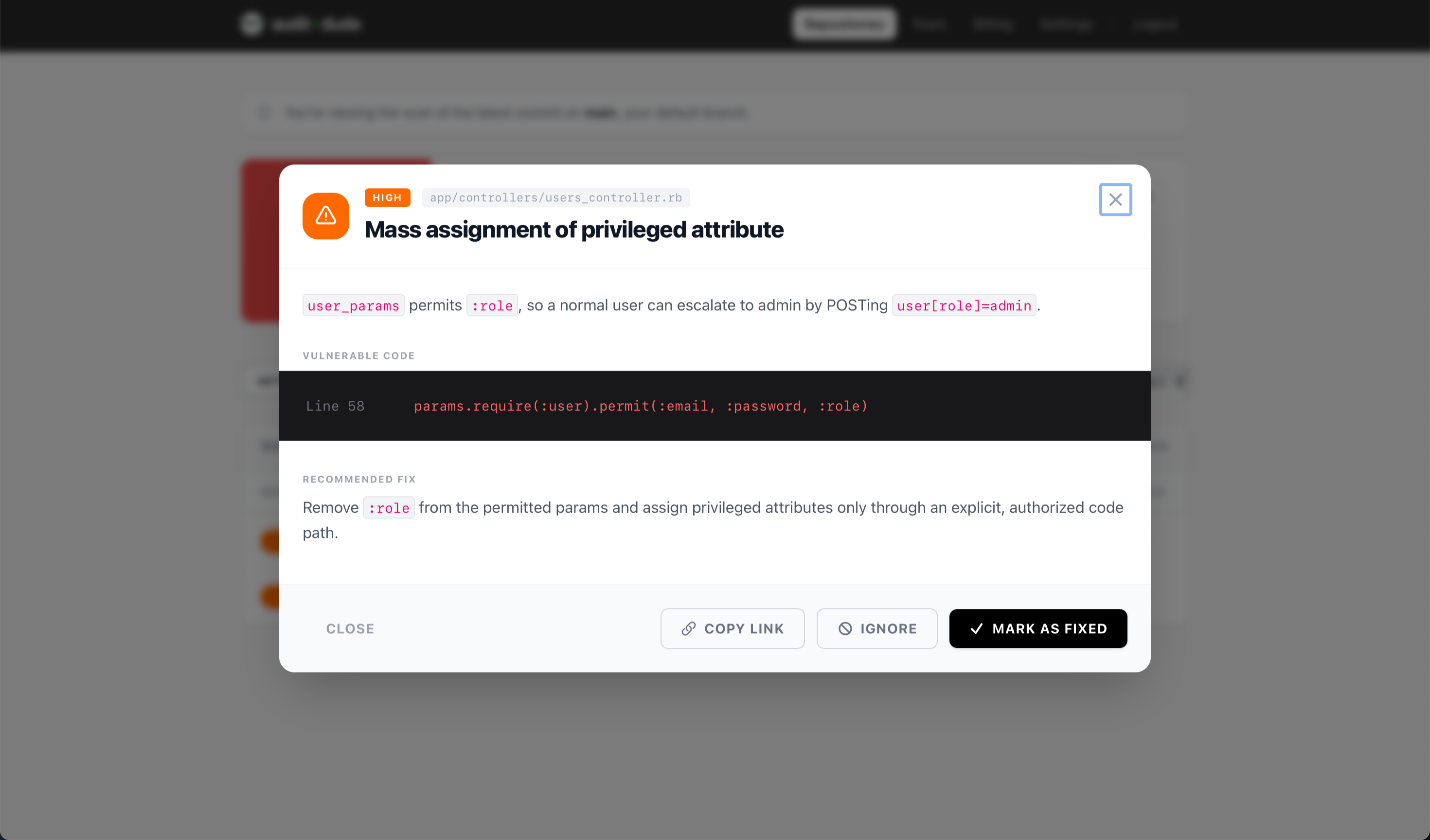
Each one verified, with the exact line, severity, and the fix. Nothing exploitable? You'll know that too.
Built into your workflow
Runs on every push.
It lives in your pull requests. Block the merge on a critical finding, or just collect the green check. Results land before your next standup.
Signal, not noise
We drop more findings than we show you.
Before anything reaches you, AuditDude checks whether the bug is reachable, whether something already mitigates it, and whether it matters in your stack. If it fails any of those, you never hear about it.
Inline PR review
It comments the exact line that breaks.
There's no dashboard to remember to check. AuditDude reviews every pull request and comments on the line that introduces the vulnerability, with severity, an explanation, and the fix. You read it where you read every other review.
def search scope = Invoice.where(tenant: current_tenant) scope.where("number LIKE ?", "%#{q}%") scope.where("number LIKE '%#{params[:q]}%'")params[:q] is interpolated straight into raw SQL — any user can dump other tenants' data. Use a bound parameter:
+ scope.where("number LIKE ?", "%\#{sanitize_sql_like(params[:q])}%")The fix shows up as a pull request.
Turn it on, and after each scan of your default branch AuditDude opens a pull request with the fix already written. Review it, merge it, move on. Included with every repo at no extra charge.
fix: parameterize tenant invoice search query
Replaces the interpolated LIKE filter in invoices_controller.rb with a bound parameter, closing the Critical · SQL injection finding from this scan.
Security posture
Every commit gets a grade.
A through F, recalculated on every push. Watch the trend instead of a binary pass/fail, and drill into any commit or file across your whole history.
Powered by Claude
The best model reading your code, not a cheap one.
AuditDude runs on Anthropic's Claude, because a security review is only as smart as whatever reads the code. Your source goes to Anthropic's API and nowhere else: never used to train any model, never shared with a third party.
vs doing it yourself
“I'll just ask Claude to audit it.”
You could — once. Pasting code into a chat is a great demo, but it isn't a security process. Here's what changes when it runs as one.
Pasting your code into a chat
- Runs when you remember to ask
- Findings scroll away in a chat window
- Hallucinated bugs slip through
- Every session starts from zero
- You still write the fix
Same model, running as a process
- Runs on every push, automatically
- Comments the exact line in your PR
- Each finding verified against your source
- Ignored stays ignored, regressions get flagged
- The fix arrives as a pull request
Integrations
Findings land in Slack and Linear.
Each confirmed finding can ping a channel or open an issue the moment it's verified. Nobody copy-pastes vulnerabilities into tickets.
Slack
Critical findings ping the right channel.
AuditDude app
Critical — SQL injection in app/models/user.rb:42
Linear
Each finding opens a pre-filled issue.
Sanitize user input in search query
UrgentPricing
One flat price per repo.
Signing up and your first scans are free. After that you pay per protected repo, with no scan limits and no seat math.
Add as many repos as you want. Each is $30/month, billed only while it's active. Remove a repo and its billing stops.
Start free →Every repo includes
- Unlimited scans on every push
- Every finding with exact line & remediation
- Inline pull request review comments
- Auto-fix PRs after every scan, at no extra cost
- Slack & Linear integrations
- Email support
FAQ
Frequently asked questions.
Why pay for this if I can just ask Claude myself?
Claude is the engine; AuditDude is everything around it. It runs on every push automatically — you won't paste your diff into a chat after the second commit. It comments the exact vulnerable line right in your PR, verifies every finding against your real source so you never see a hallucinated bug, and remembers what you already triaged: ignored stays ignored, and a fixed issue that comes back is flagged as a regression. Pasting code into a chat window once isn't a security process.
Will AuditDude break my production environment?
AuditDude only reads your source code — it never sends requests to your running app. Analysis happens entirely on the code you push to GitHub, not on your live environment, so there's nothing to break.
How do you keep false positives so low?
Every finding is cross-referenced against your actual code context before it surfaces — whether the vulnerability is reachable, whether it's already mitigated, and how it fits your stack. Anything that doesn't hold up is dropped silently.
What AI does AuditDude use, and what happens to my code?
AuditDude is powered by Anthropic's Claude — we picked the strongest model so the findings are worth trusting. Your code is sent to Anthropic's API to be analyzed, and that's it: it's never used to train any model, never shared with third parties, and you can revoke AuditDude's access to your repos at any time.
Does this replace a manual pentest for SOC2?
For most SOC2 auditors, continuous automated code analysis covers the secure-development-lifecycle controls. If your framework explicitly requires a signed human pentest, AuditDude won't replace it — but you'll arrive at that audit with far fewer findings.
Get started
Ship your next PR with AuditDude watching.
Connect a repo and read your first findings ten minutes from now. No credit card, read-only access, revoke anytime.